How to write meeting minutes
Minutes are the part of a meeting that outlives it. Weeks later, nobody remembers who agreed to what; the minutes are the only thing that does. So it is worth knowing how to write meeting minutes that are actually useful, which mostly means writing less than you think and being clear about the few things that matter.
The common mistake is to treat minutes as a transcript: to try to get everything down, word for word, as if completeness were the goal. It isn't. A transcript is a record of what was said; minutes are a record of what was decided. The first is exhausting to produce and nobody reads it. The second is short, and people come back to it for months.
What meeting minutes are for
Before the structure, the purpose. Minutes exist to answer three questions for someone who reads them later, including the version of you who has forgotten the meeting entirely: what did we decide, who is doing what next, and why. Everything else is detail you can drop.
That framing does most of the work. If a line in your notes doesn't help answer one of those three questions, it probably doesn't belong in the minutes. The tangent about the office coffee machine was a real part of the meeting; it is not part of the record.
What to capture, and what to leave out
Capture decisions, the action items that follow from them, and the owner and rough deadline for each. Capture the handful of points that explain why a decision went the way it did, because future-you will want the reasoning, not just the outcome. Note who was there, and the date, so the record can be placed in time.
Leave out the back-and-forth. You don't need every argument that led to a decision, only the decision and a sentence of context. You don't need verbatim quotes unless the exact wording genuinely matters, which is rare. And you don't need to record the parts of the meeting where nothing was concluded; "we discussed the budget for twenty minutes" helps no one if you don't say what came of it.
A structure that works
Most useful minutes follow roughly the same shape, whatever the meeting. You don't have to be rigid about it, but having a default means you are never staring at a blank page wondering where to start.
| Section | What goes in it |
|---|---|
| Heading | The meeting's name, the date, and who attended |
| Summary | Two or three sentences on what the meeting was about and where it landed |
| Decisions | Each decision made, with a line of context on why |
| Action items | What happens next, each with an owner and a deadline |
| Notes | Anything worth keeping that isn't a decision or an action |
The action items are the part people return to, so give them the most care. An action without an owner is a wish, and an owner without a deadline is an open loop. "Alice to send the revised contract by Friday" is an action item; "we should sort out the contract" is not.
How to write meeting minutes, step by step
The mechanics are simple once the meeting is over. Start with the heading and the date while they are fresh. Write the two or three sentence summary first, because forcing yourself to say what the meeting was about makes the rest easier to sort. Then go through and pull out the decisions, giving each one a single line of context. From each decision, write down the action it creates, who owns it, and when it is due. Finally, drop in any notes worth keeping that don't fit the other sections, and delete everything else.
The hard part is not the writing; it is having paid enough attention during the meeting to know what to write. That is the real tension in note-taking, and it is worth being honest about: you can listen properly or you can write things down, and doing both at once means doing neither well. The fix further down is to stop trying.
A worked example
Here is the kind of thing people scribble during a meeting:
talked about Q3 launch, Sam not sure about the date, marketing need more time, Priya said design is basically done, someone mentioned the pricing page still needs copy, agreed to push?? check with Sam, contract thing still open
It is not nothing, but a week later it is close to useless. You can't tell what was decided, the owners are vague, and "push??" could mean anything. Here is the same meeting as minutes:
Q3 launch planning, 18 June, with Sam, Priya, and Alex.
We reviewed readiness for the Q3 launch and agreed to move the date back two weeks to give marketing time to prepare.
Decisions: launch moves from 1 July to 15 July, because marketing needs the extra two weeks and design is already complete.
Actions: Alex to confirm the new date with Sam by Thursday. Priya to write the pricing page copy by 8 July. Alex to chase the outstanding contract and report back next week.
Same meeting, a fraction of the words, and every line earns its place. That is the standard to aim for.
Common mistakes
The biggest one is writing too much, treating fullness as the goal and ending up with a wall of text nobody opens. The second is the opposite: notes so sparse that the decisions have no context and the actions have no owners. The third is the slow killer, which is writing decent minutes and then never sending them, so the action items never become anything. Minutes that stay in your notes app are minutes that didn't happen. Write them, then put them where the people who need them will see them.
Letting the meeting write its own minutes
All of the above assumes you are doing the work by hand, during the meeting, which is the part that pulls your attention away from the conversation. You can also let the meeting record itself and have the minutes assembled for you afterwards.
This is what talat is built for. It records the call on your own machine, with no bot joining and nothing uploaded, transcribes it as you go, and attributes each line to the person who said it. When the meeting ends, a model running on your computer reads the whole transcript and writes a summary, breaks the meeting into chapters, and pulls out the action items with their owners. The structure from earlier in this guide, produced for you, without you having looked away from the conversation once.
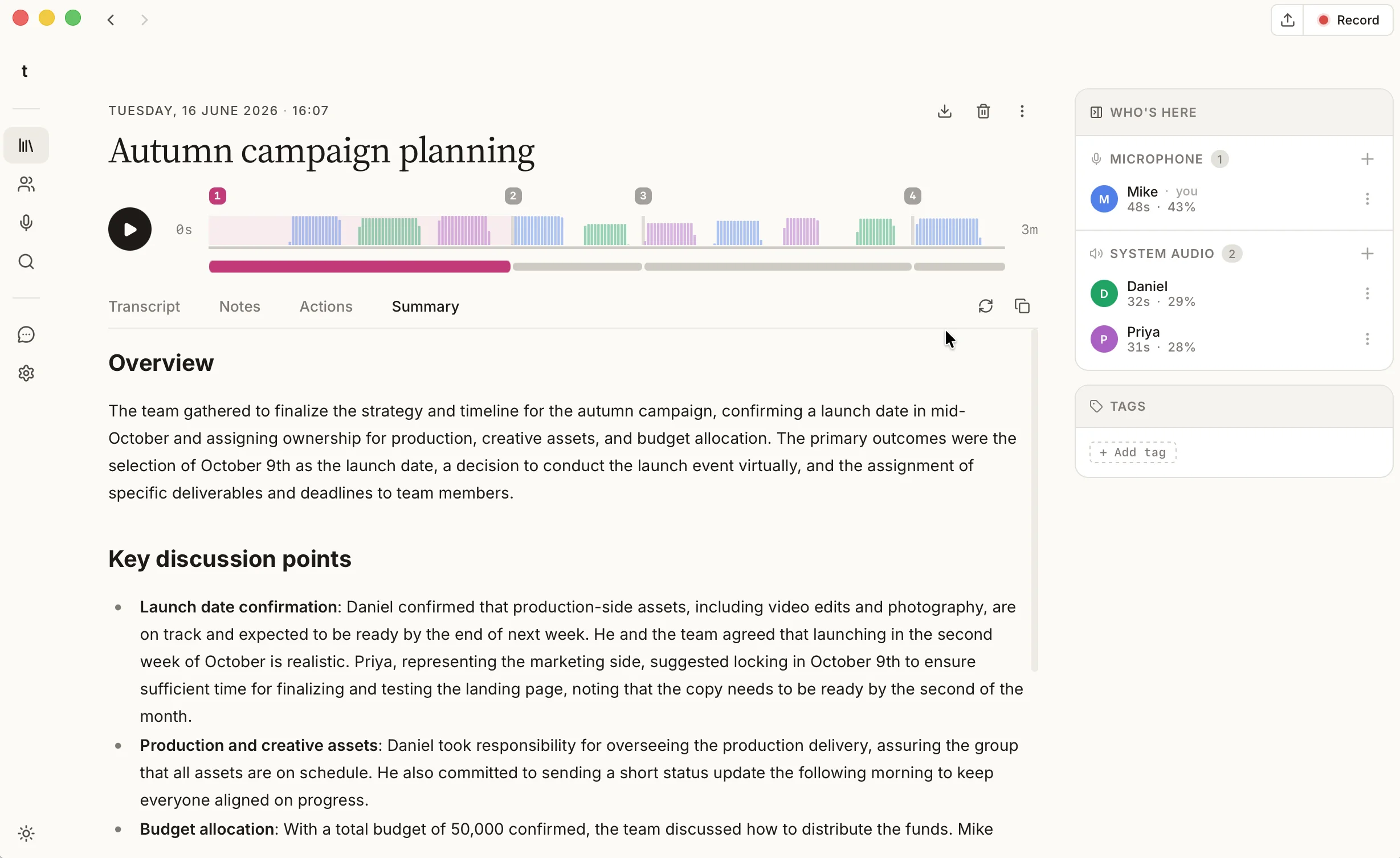
The privacy part is the point, not a footnote. The recording, the transcript, and the summary all live in a local database on your machine, and the model that writes them ships inside the app, so your meeting never leaves your computer. If you would rather a cloud model wrote sharper summaries you can connect one with your own key, but that is off by default and entirely your call. It is a different bargain from the cloud note-takers that send every call to someone else's servers; if you are weighing those up, we keep an honest comparison with the tools people usually consider.
Naming who said what is what makes the action items know whose they are, and that part gets easier over time; the guide to taking notes in a meeting covers how talat learns to recognise the people you meet regularly.
The short version
Good meeting minutes record what was decided and what happens next, not every word that was said. Lead with a short summary, list the decisions with a line of context each, give every action an owner and a deadline, and cut the rest. Then send them. Or let talat record the meeting and assemble the minutes for you on your own machine, so you can pay attention to the conversation and still come away with a clean record. You can try it free for ten hours, with no account.